Metal markets often shift before headlines do, offering a quiet preview of economic cycles. The price movements of metals usually reflect changes in industrial demand, investor sentiment, and macroeconomic trends. While their relationship with broader economic indicators is complex and multifaceted, decoding these patterns can reveal powerful insights into the direction of the economy.
Despite their predictive power, metal markets remain one of the most underutilized tools in macroeconomic analysis. In this blog, we explore how metal markets behave, what drives their fluctuations, and the economic signals they convey.
Metals and Their Price Dynamics
To unravel what metals tell us about the economy, we first examine how their prices move in relation to one another. For that purpose, we collected historical monthly prices of Aluminum, Iron ore, Copper, Lead, Tin, Nickel, Zinc, Gold, Platinum, and Silver starting from 1970. Then we calculated the correlation between the price growth of these commodities.
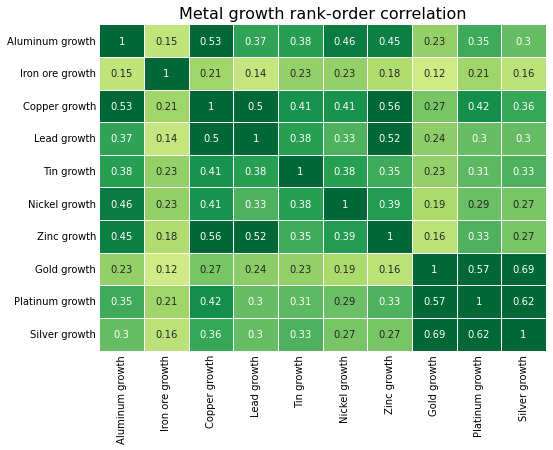
We use Spearman correlation to eliminate the impact of outliers, although a more common Pearson correlation produced a similar correlation matrix.
We can see a strong correlation among the precious metals (Gold, Platinum, and Silver) in the lower right corner of the matrix, and a relatively high correlation between industrial commodities (Aluminum, Iron ore, Copper, Lead, Tin, Nickel, and Zinc). Iron ore tends to exhibit a weaker correlation with other industrial metal prices because its supply and demand are dominated by a few key players, resulting in more isolated market dynamics.
The diverging behavior between industrial and precious metals stems from their roles in the economy. Industrial metals are essential inputs for manufacturing and construction, so their demand typically rises during economic expansion. In contrast, precious metals primarily serve as safe-haven assets, valued for their role in preserving wealth during economic uncertainty.
It’s important to recognize that there is no clear-cut distinction between industrial and precious metals. Some investors prefer to have an exposure to the industrial metals in their portfolio for diversification and risk management purposes. Meanwhile, Gold, Platinum, and Silver are used in the manufacturing of electronics and automotive components, which means that the industrial activity can materially influence their demand.
Metal Price Trends Through Economic Cycles
Industrial and precious metal prices tend to have diverging dynamics across economic cycles. During the economic expansion, heightened manufacturing and construction activities boost demand for industrial metals, driving their prices up. On the other hand, Gold and other precious metals often underperform due to a lower safe-haven demand and investors’ preference for growth assets.
When a recession hits, a significant slowdown in manufacturing and construction activities crushes the demand for industrial metals, resulting in declining prices. Subsequent destocking of industrial metals can further accelerate their price decline. In contrast, the demand for gold and other precious metals tends to rise during recessions due to the flight to safety. Additionally, the central bank rate cuts lower the opportunity cost of holding non-yielding assets, reinforcing the appeal of precious metals.
The Impact of Inflation on Metal Prices
Industrial metal prices tend to rise during periods of high inflation. This trend is driven by increases in energy and other general commodity prices, as well as higher labor costs. Additionally, demand for industrial metals may grow as investors seek tangible assets to hedge against inflation.
Gold and other precious metals exhibit strong performance when inflation surges. Investors consider them a reliable protection for their cash, which preserves the purchasing power. Besides, during debasement trades, when concerns arise about a government’s fiscal health and the declining currency value, capital often flows into safe-haven precious metals such as Gold.
The Ripple Effect of Rising Rates on Metal Prices
High inflation often leads to rising interest rates, which puts downward pressure on metal prices. For industrial metals, higher rates translate into increased inventory carrying costs, leading to destocking and a reduction of new purchases. Additionally, the strengthening dollar typically hurts the demand by making dollar-denominated metals more expensive for foreign buyers, further pressuring the metal prices.
The adverse effect of the rising interest rates is even more pronounced for precious metals. As noble commodities offer no yield, their relative appeal wanes in the face of increasingly attractive interest-bearing assets. With sharply rising opportunity costs, capital tends to rotate out of precious metals into higher-yielding bonds. Compounding the pressure, a stronger dollar reduces foreign demand, further accelerating the decline in prices for Gold and its peers.
Metal Price Dynamics in Deflationary Environments
During deflationary periods, when the prices of goods and services experience a sustained decline, commodities often fall out of favor with investors. With inflation no longer a concern, traditional hedges like Gold lose appeal, as holding them can erode purchasing power. This shift in sentiment typically results in falling prices for precious metals.
At the same time, weak consumer and business demand dampens industrial and manufacturing activity. As production slows, the need for industrial metals such as Copper, Aluminum, and Zinc declines, triggering downward pressure on their prices as well.
Other Factors Influencing Metal Prices
Beyond traditional economic indicators, metal prices are also shaped by a range of external factors. Geopolitical tensions can disrupt mining operations or trade flows, leading to sudden price spikes. Supply constraints, such as labor strikes, environmental disasters, or logistical bottlenecks, often tighten availability and push prices higher. China’s demand plays a significant role, especially in industrial metals, as shifts in its manufacturing, infrastructure, or green energy policies ripple through global markets.
Meanwhile, regulatory bottlenecks, such as strict environmental standards, export controls, or tariffs, can alter production costs and supply dynamics, adding another layer of volatility to metal pricing. For example, the rise of industrial metal prices during falling PMI and sluggish GDP can indicate regulatory bottlenecks or supply-side pressure.
Decoding the Signals from Metal Markets
Industrial and precious metal prices can serve as a leading indicator for economic activity and financial stability.
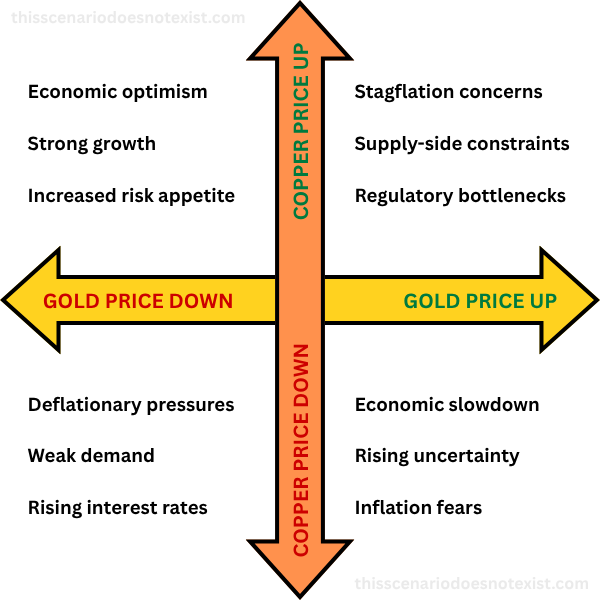
- Rising industrial metal prices and falling precious metals suggest economic optimism, strong growth, and increased risk appetite.
- Falling industrial metals and rising Gold and Silver prices point to an economic slowdown, rising uncertainty, or inflation fears.
- Both industrial and precious metals are rising. This may indicate stagflation concerns (inflation without growth), supply-side constraints, or regulatory bottlenecks.
- Both industrial and precious metals are falling. This could signal deflationary pressures or a broad-based demand collapse.
The quadrant graph below summarizes the signals from metal markets using Copper and Gold as dominant representatives of industrial and precious metals, respectively.
How Metal Prices Have Moved in Recent Years
Let’s look into the major movements of industrial and precious metal prices in the past several years, using Copper and Gold as an example.
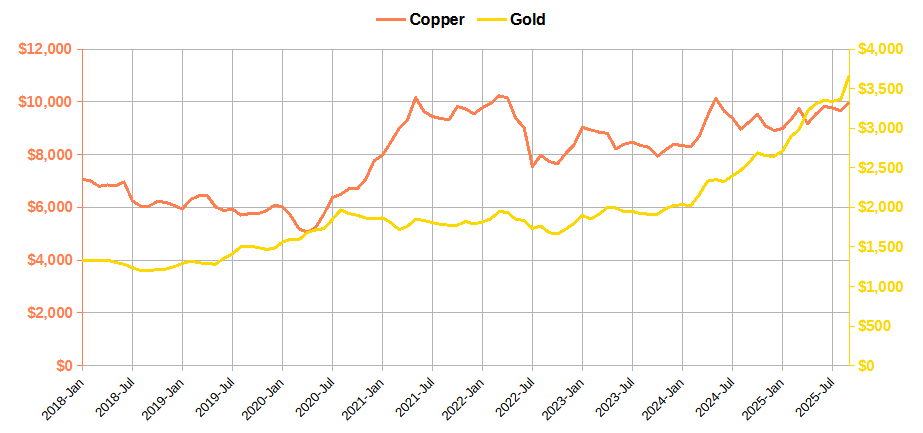
During 2018-2019, the Copper price declined due to the U.S.-China trade tensions and slowing global manufacturing activity. At the same time, the uncertainty surrounding the trade dispute and expectations of a more dovish Fed stance pushed the Gold price modestly up.
In early 2020, the Copper price sharply dropped due to the worldwide COVID lockdowns and demand collapse. By the second half of 2020, the Copper price rebounded sharply, driven by recovery optimism, China’s stimulus, and supply constraints. The strong Copper rally continued into early 2021, supported by booming green technology and EV demand. Additionally, inflation concerns further boosted investor interest in Copper.
Meanwhile, Gold prices surged in early 2020 due to COVID lockdowns, flight to safety, and unprecedented monetary stimulus. In 2021, Gold traded rangebound, as optimism about economic recovery offset rising bond yields and inflation concerns.
In 2022, Copper prices declined, pressured by aggressive interest rate hikes, China lockdowns, and recession fears. The Gold price experienced a milder decline, weighed down by Fed tightening and a stronger dollar, but supported by safe-haven demand amid geopolitical risk from the Russia-Ukraine conflict.
From 2023 through 2025, Copper prices recovered steadily, driven by China’s reopening, AI-related datacenter and energy infrastructure buildouts, supply bottlenecks, and disruption in mines.
Gold price rose in 2023 due to regional banking stress in the U.S. and safe-haven flows, further supported by conflict in the Middle East. In 2024-2025, Gold accelerated to record highs, propelled by central bank gold purchases amid de-dollarization efforts, and inflation fears linked to new tariffs and fiscal policy.
Summary
In reality, multiple factors simultaneously influence industrial and precious metal prices. In short, while industrial metals tend to reflect economic activity more directly, precious metals respond to a broader mix of macro, geopolitical, and financial factors. A key point is that Copper needs a factory running while Gold needs a worried investor. This makes industrial metals leading economic indicators, while precious metals are a leading fear indicator.
We offer AI-generated metal price scenarios. Reach out to learn more.